How Spicy Is Korean Food? A Heat Guide for Visitors
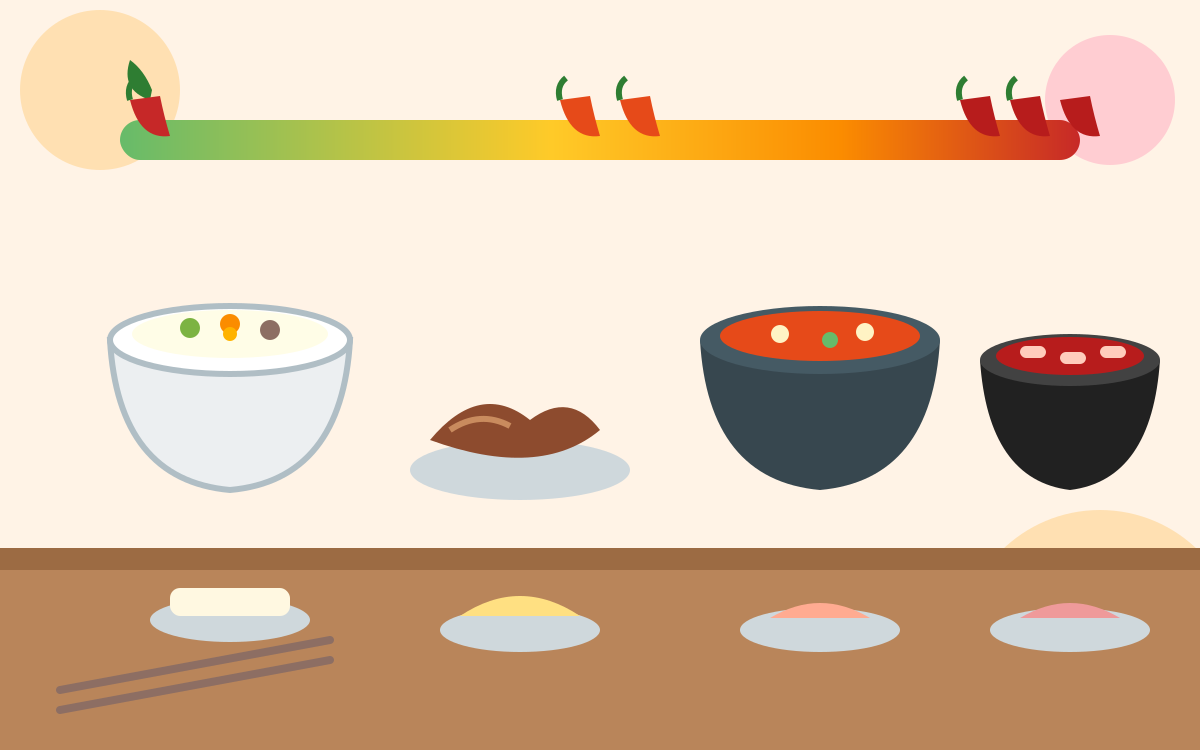
Korean food ranges from mild to very hot, so not everything is spicy. Bulgogi, galbi, japchae, mandu, samgyetang and jajangmyeon are generally mild, while stews and tteokbokki often burn. Say “deol maepge haejuseyo” for less spicy, and ask for sauces on the side.
- Heat source
- Chili powder (gochugaru) and paste (gochujang)
- Mild dishes
- Bulgogi, japchae, mandu, samgyetang
- Ask for less heat
- 덜 맵게 해주세요 (deol maepge haejuseyo)
- Cool down
- Rice, steamed egg, milk or a yogurt drink
What should I know before I arrive?
Information checked October 27, 2026
Korean food is not uniformly hot: it ranges from mild grilled meat and noodle dishes to very spicy stews, and you can usually steer toward the heat level you want. Spiciness comes mainly from chili powder (gochugaru) and chili paste (gochujang), so the amount differs from dish to dish and shop to shop.
- Worth knowing: The official VisitKorea jang article says the introduction of chili pepper “turned Korean cuisine on its head,” and that gochugaru turned plain salted-vegetable kimchi into the modern kind.
- A common mistake: Assuming a familiar dish is mild. Stars and Stripes Korea (March 5, 2026) warns that even seemingly mild tteokbokki can be quite spicy.
- Local tip: Spice levels vary by restaurant, per 10 Magazine, so ask when you order rather than relying on a dish name alone.
What makes Korean food spicy?
The heat comes mostly from gochugaru (red chili powder) and gochujang (fermented chili paste), used in kimchi, stews, marinades and sauces. According to Taste Korean Food, Portuguese traders brought chili peppers to Korea in the 16th century, and Korean chilies are described as balancing heat with sweetness. The VisitKorea page says gochujang is a base for bibimbap, tteokbokki and spicy seafood salads, and that its sweetness depends on the starch used, such as glutinous rice or barley.
- Gochujang is one of the jang sauces. Korea.net describes it as a spicy red pepper paste and notes that UNESCO recognized Korea’s jang-making culture as Intangible Cultural Heritage of Humanity on December 4, 2024.
- Not every sauce is hot. Soy sauce (ganjang) flavors bulgogi, and the same Korea.net article describes ssamjang as a thick, spicy soybean-paste sauce served with samgyeopsal.
- Heat can be added later. Mummy Travels notes that gochujang and gochugaru are often served on the side, so you can add them yourself.
Practical example: a visitor ordering bibimbap can ask for the gochujang on the side, taste the rice bowl first, and stir in the paste a little at a time. For general ordering etiquette, see how to order at a Korean restaurant.
Which dishes are spicy and which are mild?
Stews, tteokbokki, stir-fried octopus and buldak dishes tend to be hot, while bulgogi, galbi, japchae, mandu, samgyetang and jajangmyeon are generally mild. The table below combines three food guides; heat varies by restaurant, so treat it as a starting point.
| Heat | Dishes | Source note |
|---|---|---|
| Mild or not spicy | Bulgogi, galbi-jjim, japchae, mandu, samgyetang, jajangmyeon, haemul pajeon, doenjang-jjigae, kimbap | Shuttle Delivery, TheSmartLocal, Mummy Travels |
| Beginner heat | Kimchi side dish, budae-jjigae, jjamppong, ganjang jjimdak | 10 Magazine |
| Intermediate heat | Tteokbokki, jeyuk-deopbap, dakdoritang, eolkeun noodles | 10 Magazine |
| Advanced heat | Nakji or jjukkumi bokkeum, spicy jokbal, buldakbal, buldak stir-fried noodles | 10 Magazine |
Look for the syllable eolkeun (얼큰) in a name, which 10 Magazine says marks a spicy version of a normal dish. The same guide gives milder substitutes, such as jjajang tteokbokki instead of regular tteokbokki. Mummy Travels also lists ganjang (soy sauce) tteokbokki and the white, non-spicy version of seafood soft tofu stew. Heat is not only a menu matter: Sous Chef (April 2024) puts original Buldak instant noodles at about 4,404 Scoville units, a figure we could not confirm with the manufacturer.
For ideas beyond the mild list, see our 20 Korean dishes to try on your first trip and the Korean street food guide.
How do I ask for less spicy food in Korean?
Say “deol maepge haejuseyo” (덜 맵게 해주세요) for less spicy, or “an maepge haejuseyo” (안 맵게 해주세요) for not spicy. 10 Magazine, KoreanClass101 and Stars and Stripes Korea all give these phrases.
| English | Korean | Romanization |
|---|---|---|
| Is this spicy? | 이거 매워요? | Igeo maewoyo? |
| Please make it less spicy. | 덜 맵게 해주세요 | Deol maepge haejuseyo |
| Please make it not spicy. | 안 맵게 해주세요 | An maepge haejuseyo |
| A little spicy, please. | 약간 맵게 해주세요 | Yakgan maepge haejuseyo |
| What is the least spicy one? | 제일 안 매운 것이 뭐예요? | Jeil an maeun geosi mwoyeyo? |
Menus may also use spice words: 10 Magazine lists 순한맛 (mild), 보통맛 (normal), 매운맛 (spicy) and 아주 매운맛 (very spicy), and says some menus use pepper icons instead. Stars and Stripes Korea adds that 매운 (maeun), 고추 (gochu, chili) and 양념 (yangnyeom, seasoned, often a spicy sauce) are words that signal heat. Papago or Google Translate can scan a menu photo if you cannot read the text; see our essential apps guide.
What if my food is too spicy?
Reach for plain rice, a mild side dish, milk or a yogurt drink rather than water. 10 Magazine suggests rice balls or a yogurt drink in a restaurant and milk at home or from a convenience store, and TheSmartLocal notes that steamed egg (gyeran-jjim) often appears on the menu at spicy-food restaurants to offset heat.
- Red banchan: Mummy Travels says you can spot spicy side dishes by their red color and skip them; steamed egg and fish cake are milder choices.
- Kimchi: Ask for baek kimchi (white kimchi, made without chili) or simply move the red kimchi aside.
- Children: Ask for 순한맛 (sunhan-mat, mild), as in the 10 Magazine phrase “aiga isseunikka sunhan-matsseuro juseyo.” Not every restaurant has a children’s menu.
If you avoid meat as well as spice, our vegetarian and vegan guide covers hidden fish stock.
How do I order a mild meal step by step?
Choose a naturally mild dish, check the heat level, ask for adjustments, and keep a plain side ready.
- Start mild. Pick bulgogi, galbi, japchae, mandu, samgyetang or jajangmyeon from the table above.
- Check the menu words. Look for 매운 (maeun), 얼큰 (eolkeun) or red pepper icons, and avoid those on the first try.
- Ask. Say “igeo maewoyo?” to check, then “deol maepge haejuseyo” if you want it milder.
- Ask for sauces on the side. Gochujang and ssamjang can be added a little at a time.
- Add a cooling side. Order rice, steamed egg or a drink such as milk or a yogurt drink to balance the meal.
FAQ
Is all Korean food spicy?
No. Dishes such as bulgogi, galbi, japchae, samgyetang, mandu, jajangmyeon and plain bibimbap are described by food guides as mild or not spicy, while stews, tteokbokki and buldak dishes are often hot.
How do I ask for less spicy food in Korean?
Say "deol maepge haejuseyo" (덜 맵게 해주세요) for less spicy, or "an maepge haejuseyo" (안 맵게 해주세요) for not spicy. Kitchens may not be able to change every dish, so ask when you order.
Is kimchi always spicy?
Most kimchi is made with chili powder (gochugaru), so it is usually spicy. Baek kimchi, or white kimchi, is made without chili and is milder, according to Mummy Travels.
What should I drink or eat if my mouth is burning?
Food guides suggest milk, a yogurt drink or plain rice instead of water. Many spicy restaurants also serve steamed egg (gyeran-jjim) to offset the heat.
Are the heat levels the same in every restaurant?
No. 10 Magazine warns that spice levels vary by restaurant, so a dish listed as medium heat can be much hotter in some places. Ask staff if you are unsure.
Official sources and useful links
Links open in a new tab. Heat levels vary by restaurant; verify with staff and these pages.
- Shuttle Delivery list of 10 non-spicy Korean dishes with tips
- TheSmartLocal 12 non-spicy Korean foods (published April 21, 2022; modified October 5, 2022)
- 10 Magazine survival guide with spice levels, phrases and cooling tips
- Mummy Travels mild dishes for children and tips on red banchan and white kimchi (updated July 1, 2026)
- Stars and Stripes Korea guide to reading a Korean menu (March 5, 2026)
- KoreanClass101 survival phrases for asking about spice
- Taste Korean Food history and culture of gochujang
- Korea.net official Korean government site: article on gochujang and UNESCO jang recognition (December 18, 2024)
- VisitKorea jang article Korea Tourism Organization on gochujang and chili peppers (February 20, 2025)
- Sous Chef Buldak noodle heat figure (April 25, 2024)
- VisitKorea (Korea Tourism Organization) official tourism information in English
- Visit Seoul official Seoul city tourism site
Disclosure: This site shows ads served by Google AdSense, and some links may be affiliate links that earn a small commission at no extra cost to you. This never affects our recommendations. Prices and rules change, so please confirm details with the official sources before you travel.